.webp)

On February 2, 2026, SpaceX acquired xAI in a deal that creates the world's most valuable private company at $1.25 trillion. This transaction has significant implications for shareholders and employees of SpaceX, xAI, and X (formerly Twitter, which xAI acquired in March 2025).
This guide provides an overview of how this acquisition affects your equity, including the mechanics of stock conversion, dilution, and what your ownership stake will represent before and after the transaction.
Axon Capital Management provides wealth planning services for SpaceX shareholders and employees. This guide is for informational and educational purposes only and does not constitute personalized financial, legal, or tax advice. Readers evaluating equity decisions following the acquisition may schedule a consultation.
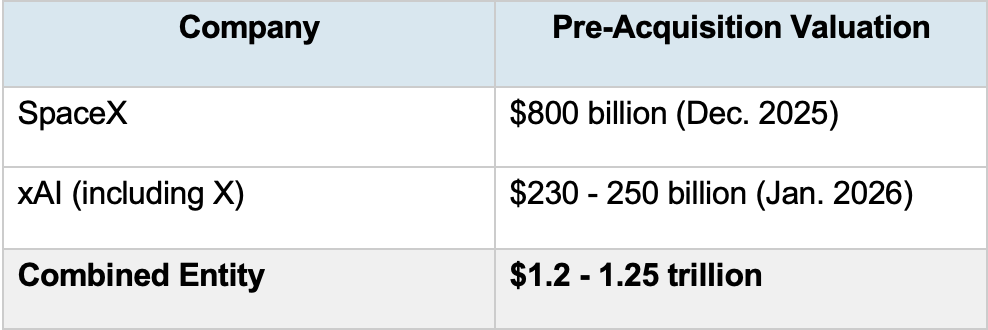
This is an all-stock acquisition, meaning SpaceX is acquiring xAI by issuing new SpaceX shares to existing xAI shareholders. No cash is changing hands in this transaction.
In an all-stock acquisition, the acquiring company (SpaceX) issues new shares to purchase the target company (xAI). The conversion ratio determines how many shares of the acquirer each shareholder of the target receives in exchange for their existing shares.
The conversion ratio is determined by the relative valuations of the two companies at the time of the transaction. In this case, with SpaceX valued at approximately $1 trillion and xAI valued at approximately $250 billion post-deal, xAI represents roughly 20% of the combined entity.
While xAI represents roughly 20% of the combined company by valuation, the reported exchange ratio of 0.1433 is determined by the relative per-share values of each company — not their total valuations. Differences in shares outstanding, preferred stock structures, and capitalization can result in a conversion ratio that appears lower than the ownership percentage might suggest.
While the exact exchange ratio has not been publicly disclosed, we can estimate the mechanics based on the reported valuations. Here's how the calculation works:
• SpaceX pre-acquisition valuation: $800 billion
• xAI acquisition valuation: $250 billion
• Combined valuation: $1.25 trillion (includes premium to SpaceX valuation)
• xAI ownership in combined entity: approximately 20% ($250B / $1.25T)
• SpaceX ownership in combined entity: approximately 80% ($1T / $1.25T)
Dilution Effect:
Existing SpaceX shareholders experience ownership dilution as new shares are issued to acquire xAI. However, they gain ownership in a larger, more diversified company.
Before the Transaction:
• You owned X% of SpaceX
• SpaceX was valued at $800 billion
After the Transaction:
• You now own approximately (X% × 80%) of the combined entity
• Your percentage ownership decreased by 20%
• However, the combined entity is valued at $1.25 trillion, representing significant appreciation
Example Calculation:
If you owned 1% of SpaceX:
• Pre-acquisition value: 1% of $800B = $8 billion
• Post-acquisition: You now own 0.8% of the combined entity (1% × 80%)
• Post-acquisition value: 0.8% of $1.25T = $10 billion
• Value increase: $2 billion (25% gain despite 20% dilution)
If you owned equity in xAI before the acquisition, here's what happens:
Before the Transaction:
• You owned X% of xAI
• xAI was valued at approximately $230-250 billion
• Your equity represented ownership in both xAI's AI technology and the X social media platform
After the Transaction:
• Your shares have been converted to SpaceX stock
• You now own approximately (X% × 20%) of SpaceX
• Your equity now represents ownership in a combined entity including: SpaceX's rocket and satellite operations, Starlink internet service, xAI's artificial intelligence technology, and the X social media platform.
Example Calculation:
If you owned 1% of xAI:
• Pre-acquisition value: 1% of $250B = $2.5 billion
• Post-acquisition: You now own approximately 0.2% of SpaceX (1% × 20%)
• Post-acquisition value: 0.2% of $1.25T = $2.5 billion
X shareholders experienced a two-step conversion process:
Step 1 (March 2025): X acquired by xAI
• X shareholders received xAI stock in exchange for their X shares
• X was valued at $33 billion (equity), xAI at $80 billion at that time
• X represented approximately 29% of the combined xAI-X entity ($33B / $113B total enterprise value)
Step 2 (February 2026): xAI acquired by SpaceX
• Former X shareholders (now xAI shareholders) received SpaceX stock
• Their xAI shares were converted alongside all other xAI shareholders
Net Result:
If you owned 1% of X in March 2025:
• After xAI acquisition (March 2025): You owned approximately 0.29% of xAI (1% × 29%)
• After SpaceX acquisition (February 2026): You now own approximately 0.058% of SpaceX (0.29% × 20%)
As private companies, both SpaceX and xAI may have multiple share classes with different rights and preferences:
• Common Stock: Typically held by founders, employees, and early investors. Generally has voting rights but is subordinate to preferred stock in liquidation scenarios.
• Preferred Stock: Held by institutional investors, often with liquidation preferences, anti-dilution protection, and sometimes special voting rights.
The conversion terms may differ by share class. For example, Tesla disclosed it invested $2 billion in xAI in exchange for preferred stock, which may have different conversion terms than common stock in the SpaceX acquisition.
Vested Options:
If you had vested stock options in xAI, they will typically be converted to SpaceX options with adjusted terms:
• The number of options will be adjusted by the conversion ratio
• The exercise price will be adjusted proportionally to maintain the same economic value
• Vesting schedules may be preserved or modified depending on the acquisition agreement
Unvested Options:
Treatment of unvested options varies by company policy and individual employment agreements:
• Single-Trigger Acceleration: All unvested options vest immediately upon the acquisition closing
• Double-Trigger Acceleration: Unvested options only vest if both the acquisition occurs AND you are terminated without cause within a specified period (typically 12-18months)
• Continued Vesting: Options continue vesting on their original schedule, now as SpaceX options
• Cancellation: In rare cases, underwater options (where exercise price exceeds current value) may be cancelled without compensation
If you held RSUs in xAI:
• Vested RSUs will be converted to SpaceX shares based on the exchange ratio
• Unvested RSUs will typically be converted to SpaceX RSUs with adjusted quantities
• Acceleration provisions (single or double-trigger) may apply depending on your grant agreement
The combined entity's $1.25 trillion valuation represents a significant premium over the sum of pre-acquisition valuations:
• SpaceX pre-acquisition: $800 billion
• xAI pre-acquisition: $230-250 billion
• Simple sum: $1.03-1.05 trillion
• Actual combined valuation: $1.25 trillion
• Premium: $200-220 billion (approximately 20% above simple sum)
This premium reflects the market's expectation of synergies between SpaceX's infrastructure and xAI's artificial intelligence capabilities, particularly around the stated goal of building space-based data centers.
xAI Shareholders:
Generally benefit from:
• Access to a larger, more established company with proven revenue streams
• Reduced burn rate concerns (xAI was reportedly burning $1 billion per month)
• Potential liquidity event through SpaceX's planned IPO
SpaceX Shareholders:
Experience trade-offs:
• Ownership dilution
• But significant value appreciation (25% increase in the example above)
• Access to cutting-edge AI technology and social media platform
• Exposure to additional business risks (AI development costs, social media regulatory challenges)
Private Company Status:
SpaceX remains a private company, which means your shares are not freely tradable on public markets. However:
• SpaceX periodically offers secondary share sales, allowing employees and shareholders to sell shares at predetermined prices
• An IPO is reportedly planned for mid-2026, which would provide significant liquidity
• Until an IPO or secondary sale opportunity, your shares remain illiquid
The tax treatment of this all-stock acquisition is complex and depends on several factors:
For Share Conversions:
• This transaction may qualify as a tax-free reorganization under Section 368 of the Internal Revenue Code
• If it qualifies, you typically don't recognize gain or loss on the exchange itself
• Your tax basis in the old shares carries over to the new shares
• You'll only owe taxes when you eventually sell your SpaceX shares
For Stock Options:
• Incentive Stock Options (ISOs): Conversion typically preserves ISO status, but exercising may trigger Alternative Minimum Tax (AMT)
• Non-Qualified Stock Options (NSOs): If cashed out, treated as ordinary income; if converted, no immediate tax but ordinary income upon future exercise
For Acceleration Events:
• If unvested options or RSUs accelerate, you may owe immediate taxes on the value received
• This could create a significant tax liability even though your shares remain illiquid
IMPORTANT: Tax implications vary significantly based on individual circumstances. Consult with a qualified tax advisor before making any decisions regarding your equity.
1. Review official communications: Your company should provide formal notification of the conversion terms, including the exact exchange ratio and any changes to vesting schedules
2. Update your equity tracking: Calculate your new ownership percentage in SpaceX and the current estimated value
3. Understand vesting changes: Determine how the acquisition affects any unvested options or RSUs you hold
4. Review employment terms: If you're an employee, understand any changes to your compensation, role, or reporting structure
Given the complexity and potential tax implications, all shareholders should seek professional advice tailored to their specific circumstances. If you’d like personalized guidance on how this transaction impacts your equity, financial plan, or long-term wealth strategy, complete the form below to schedule a conversation.
Article written by Brady Lochte, founder of Axon Capital Management and a fee-only fiduciary financial advisor. Brady is committed to providing clear, transparent financial guidance that helps people navigate retirement, investing, and long-term planning with confidence.
Disclosure: The information presented in this article is for informational and educational purposes only and should not be construed as personalized financial, investment, tax, or legal advice. It is based on publicly available information and estimates that may change as additional details about the transaction emerge. Examples are hypothetical and intended for illustrative purposes only. Private company equity involves significant risks, including illiquidity, valuation uncertainty, and concentration risk, and tax outcomes vary widely based on individual circumstances. Nothing herein should be interpreted as a recommendation to take any specific action.
Please submit the form with any questions or comments and I'll be in touch shortly.
If you'd rather not wait, you can also book a time directly on my calendar using the link below:
Schedule a call
