

The money hits on a Tuesday.
One hundred thousand dollars. A single deposit, a single line in a banking app, and more money than the athlete - maybe more than anyone in their family - has ever seen in one account.
There is no pay stub. No line for federal withholding. No Social Security, no Medicare, no state tax. Just the number: $100,000.
So the athlete does what almost anyone would do. They put $35,000 toward a truck. They send $15,000 home to help with their parents’ mortgage. They take a trip with teammates. They put $20,000 into an index fund, because that’s what the smart people say to do. By the end of the season, there’s maybe $15,000 left, and the athlete feels pretty good about it. They helped their family. They invested. They didn’t blow it.
Then tax season arrives, and a preparer runs the numbers. Federal income tax. Self-employment tax. Possibly state tax. The bill comes to more than $20,000 - and in some states, closer to $30,000. It is due now, possibly with a penalty attached.
Nothing in that story is reckless. The athlete made a completely understandable mistake: they treated the deposit as if all of it were theirs. Some of it was. But a meaningful slice belonged to the government from the moment it arrived. Nobody had taken it out yet.
That is the entire NIL tax problem: the number in your bank account is not the number you get to keep.
This article is about finding the second number. Not with a magic percentage, but with a framework you can actually run - using 2026 tax figures - the day a payment lands.
Most people learn what taxes feel like from a paycheck, and a paycheck is a gentle teacher. A first-year analyst with a $100,000 salary never actually sees $100,000. Every two weeks, an employer quietly takes out federal income tax, Social Security, Medicare, and state tax before the money lands. The employee’s sense of “my money” is calibrated to the after-tax number from day one.
NIL money usually skips that step. The IRS’s own guidance on NIL income says that athletes paid as independent contractors typically have no tax withheld, and that they generally receive a Form 1099 rather than a W-2. The IRS lists everything from brand endorsements and autograph fees to school revenue-sharing payments and in-kind gear and services as NIL income. All of it is generally taxable, whether or not a 1099 ever shows up.
So the athlete’s brain gets calibrated to the wrong number. The gross amount arrives, it looks like wealth, and it gets mentally filed as “mine.” The tax bill doesn’t arrive for months, and by then the money has been absorbed into a lifestyle.
This is why NIL taxes are less a math problem than a behavioral one. The math is solvable. The harder part is that nothing in the payment itself reminds you that part of it isn’t yours.
If nobody takes the taxes out for you, you have to become your own withholding department.
That means doing, deliberately and immediately, what an employer’s payroll system does automatically: estimating the tax on each payment and moving that money somewhere you won’t spend it. The rest of this article is about how to estimate that amount well.
Federal income tax is the one everyone has heard of, and it’s progressive: each slice of taxable income is taxed at its own rate. Here are the 2026 brackets the IRS published for a single filer, which is how most college athletes file.
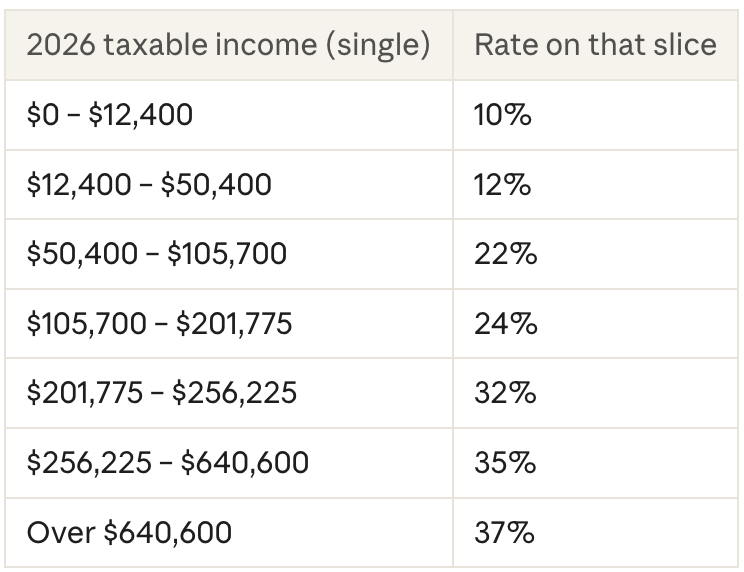
Two things about this table trip people up. First, being “in the 24% bracket” doesn’t mean you pay 24% on everything - only on the dollars inside that band. Second, the brackets apply to taxable income, which is smaller than what you were paid.
For a typical NIL athlete, three deductions do most of the shrinking:
• The standard deduction. For 2026 it’s $16,100 for a single filer. The first $16,100 of income is effectively untaxed by the income-tax system (though not, as we’ll see, by self-employment tax).
• Half of your self-employment tax. If you owe self-employment tax, the law lets you deduct half of it when figuring income tax. It’s the self-employed version of the employer’s share of payroll taxes.
• The qualified business income (QBI) deduction. Self-employed people can often deduct up to 20% of their net business income. For 2026 the full deduction is available when taxable income is below $201,750 for single filers, phasing out up to $276,750 (Rev. Proc. 2025-32 thresholds). Here’s the NIL-specific catch: the Treasury regulations specifically classify businesses built on endorsement fees, licensing your name, image, or likeness, and appearance fees as “specified service” businesses. Below the threshold that label doesn’t matter. Above it, the deduction shrinks fast and disappears entirely for high earners.
Then come the variables that make your number yours rather than an average:
Scholarships. A qualified scholarship spent on tuition, required fees, books, and required supplies is generally tax-free. The portion that covers room, board, or a cost-of-attendance stipend is generally taxable (IRS Publication 970). That taxable slice stacks on top of NIL income and pushes it into higher brackets.
Other income. A summer job, a W-2 from a camp, investment income, a revenue-share payment from your school on top of collective money — it all lands on the same return. The athlete with $100,000 of NIL and nothing else is in a different spot from the one with $100,000 of NIL plus $40,000 of revenue share.
Filing status. Nearly every college athlete files single. A married athlete files under different brackets and a different standard deduction.
Dependency. Parents may still be able to claim a full-time student under 24 as a dependent, depending on who provides more than half the student’s support. That question can affect the parents’ return and education credits as much as the athlete’s. It’s worth asking a preparer about, not guessing.
Every worker in America pays into Social Security and Medicare. If you have a regular job, you pay 7.65% of your wages and your employer quietly pays another 7.65%. You barely notice.
When you work for yourself, there is no employer. So you pay both halves. That’s self-employment tax: 15.3% in total, made up of 12.4% for Social Security and 2.9% for Medicare. It’s calculated on 92.35% of your net self-employment earnings, so the effective bite is about 14.1% of net profit.
A few mechanics matter for NIL athletes:
• It starts early. Self-employment tax applies once net self-employment earnings reach $400 for the year. There’s no standard deduction for it. Your first NIL dollar can be subject to it.
• The Social Security part has a ceiling. For 2026, the 12.4% applies to the first $184,500 of earnings. The 2.9% Medicare part has no ceiling, and an extra 0.9% Medicare tax kicks in above $200,000 for single filers.
• Half of it is deductible for income-tax purposes, as covered above.
Here’s why this tax shocks young athletes. In the models later in this article, an athlete with $25,000 of NIL income owes roughly $3,500 of self-employment tax — and only about $570 of federal income tax. At that level, Social Security and Medicare are more than 85% of the federal bill. Someone who thinks “I’m in a low bracket, I barely owe anything” is looking at the wrong tax.
Self-employment tax applies to income from a trade or business where you provide services. Most NIL deals involve services: posting on Instagram, showing up at a store opening, signing autographs, shooting a commercial, running a camp. That income is typically reported on a Form 1099-NEC and Schedule C, and self-employment tax applies.
But the IRS draws a line for pure licensing. If a company pays you solely for the right to use your name or image, and you don’t perform any active services, that payment can be royalty income reported on Schedule E and is not subject to self-employment tax. The IRS’s own example: a brand pays you a photo-shoot fee and a separate royalty for using the photos in an ad. The shoot fee is self-employment income. The royalty isn’t.
Revenue-sharing payments from schools under the House settlement add another wrinkle, because institutions have structured them differently and the characterization is still being worked out. Some arrangements may also treat an athlete as an employee, in which case payroll taxes are withheld through a W-2.
The practical takeaway: read the contract and look at which form you receive. Whether a payment is for services, a license, or wages changes the tax by up to 14 percentage points. That’s precisely the kind of question to put in front of a tax professional before you sign, not after.
Federal taxes are the same in Austin and Los Angeles. State taxes are not, and the gap is big enough to change your reserve by ten percentage points.
Texas has no individual income tax. Neither do Alaska, Florida, Nevada, South Dakota, Tennessee, or Wyoming. Washington doesn’t tax wages or business income for individuals (it does tax certain capital gains), and New Hampshire doesn’t tax earned income. For an athlete who lives and does all their NIL work in one of these states, the state line in the tax reserve can be close to zero.
California sits at the other end. Its rates run from 1% to 12.3%, plus an extra 1% on taxable income over $1 million. On the 2025 schedule (the most recent the Franchise Tax Board has finalized; 2026 thresholds are indexed later in the year), a single filer hits 9.3% at roughly $72,700 of taxable income. In our models, a California resident with $100,000 of NIL income owes roughly $4,400 in state tax on top of everything federal. At $250,000, it’s about $17,600. At $500,000, about $41,900. California also doesn’t offer the federal QBI deduction.
Most other income-tax states fall somewhere between those poles, and some — Oregon, for instance — reach high rates at fairly modest income.
State taxes depend on two things: where you’re a resident, and where you earned the income. Those aren’t always the same place.
Residency can be genuinely ambiguous for a college athlete. A player from California attending school in Texas may still be a California resident in the eyes of California, depending on where their permanent home, family, driver’s license, voter registration, and long-term intentions are. That’s a question with real money attached.
Source matters too. The IRS explicitly tells NIL athletes to track where they perform NIL services, because a state where you earn income can tax it. A Texas resident who flies to Los Angeles for a two-day commercial shoot may have California-source income and a California nonresident return to file.
This is the college cousin of the “jock tax” that professional athletes deal with, where states tax visiting players on the portion of salary earned on game days in that state. Most college athletes won’t face the full pro-style version, but anyone doing paid appearances, shoots, or camps across state lines should keep a simple log: date, location, deal, amount.
And a handful of cities and local jurisdictions - several in Ohio, Pennsylvania, and Missouri, for example - tax earned income or self-employment profits on top of state tax. If you live or work in one, it belongs in the reserve too.
The most common advice is “just set aside 30%.” It’s not bad advice. It’s simple, it’s memorable, and for a lot of athletes in the middle of the income range it lands in the right neighborhood. A rule people actually follow beats a precise calculation nobody does.
But 30% is a rule of thumb, not a tax calculation. Run the 2026 numbers and it turns out to be too much at the low end and not nearly enough at the high end, especially in a high-tax state. In our models, a Texas athlete with $25,000 of NIL income owes about 16%. A California athlete with $500,000 owes about 42%. Same rule, very different outcomes.
The reason is that “30%” quietly assumes answers to a dozen questions: how much of the money is self-employment income, what state you live in and where you did the work, whether you have deductible business expenses, whether you have other income, how much of your scholarship is taxable, whether anyone withheld anything, and whether you’re above or below the QBI phase-out.
To see how much those answers matter, take three athletes who each receive exactly $100,000 in NIL money in 2026.
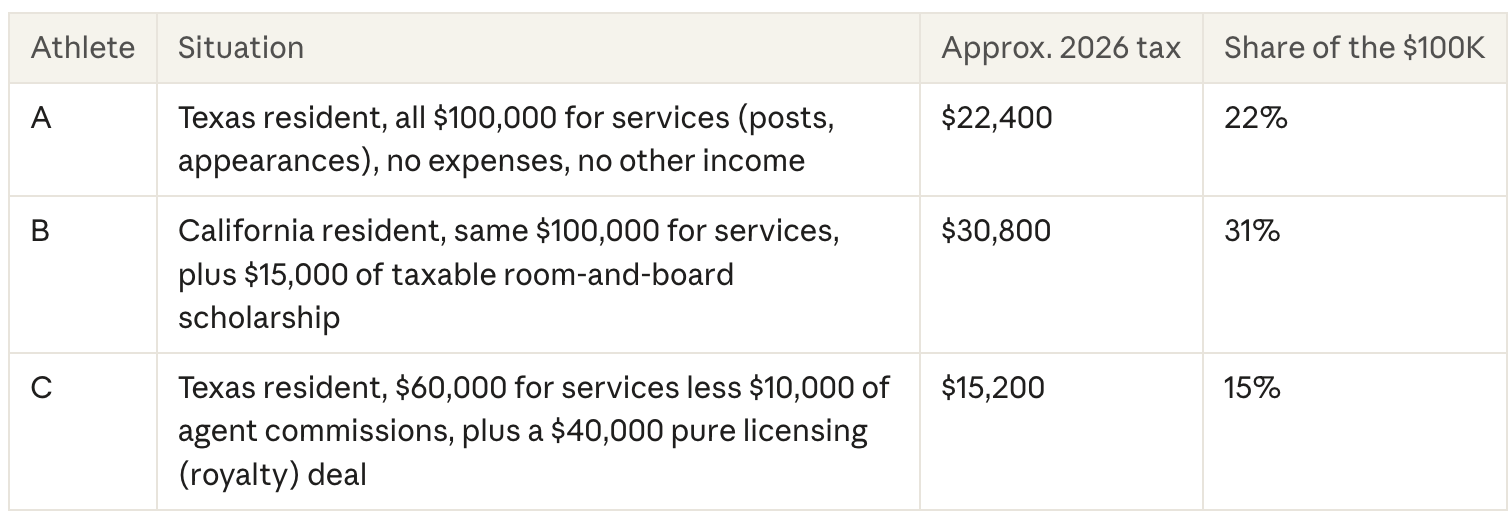
Same headline number. Tax bills that differ by a factor of two. Athlete B owes more because of state tax and because the taxable stipend pushes NIL income into higher brackets. Athlete C owes less because the commissions are deductible and the royalty isn’t subject to self-employment tax.
So here’s the clearest answer this article can give:
There is no universal percentage. But if you receive an NIL payment with no tax withheld, a reasonable starting reserve is roughly 20–25% at modest income, 25–33% in the middle, and 33–45% at high income — using the low end of each range if you live and work in a no-income-tax state, and the high end if you’re in a high-tax state.
Those ranges deliberately run a few points above the modeled tax, because estimates miss, deals get added mid-year, and owing less than you saved is a pleasant problem. Once a tax professional has looked at your actual contracts, you can tighten the number.
Or, in the simplest possible terms: if $100,000 lands in your account tomorrow and no taxes were withheld, about $70,000 of it is spendable money. The other $30,000 is a bill that hasn’t arrived yet.
Here’s what the 2026 rules produce at five income levels. These are models, not tax bills, so the assumptions matter. Each example assumes the athlete:
• files as a single taxpayer for 2026 and takes the $16,100 standard deduction;
• earns all NIL income for active services (so it’s self-employment income), with no business expenses and no other taxable income;
• has no tax withheld;
• claims the QBI deduction, treating NIL as a specified service business subject to the 2026 phase-out;
• lives in Texas (no state income tax) or, for the California column, is a California resident taxed on the 2025 California schedule as a proxy for 2026.
Under those assumptions, the modeled tax looks like this:
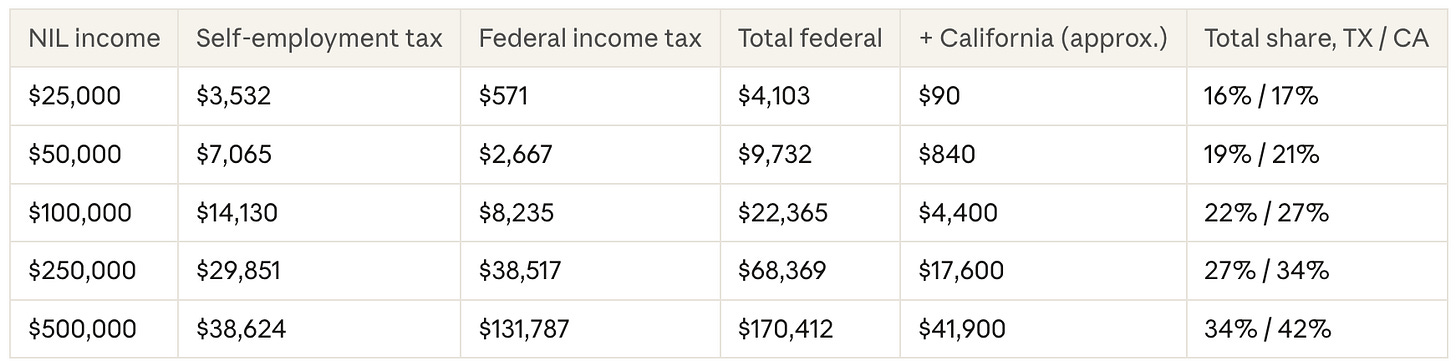
A few things jump out.
At $25,000, the income tax is almost an afterthought. The standard deduction and the low brackets wipe out most of it. Self-employment tax does not care about any of that. This is the athlete most likely to say “I didn’t think I’d owe anything” — and then owe $4,000.
At $50,000 and $100,000, the two federal taxes start to share the load. Income tax grows quickly as more dollars land in the 22% bracket. By $100,000, the federal bill is about $22,000 even in Texas, and the QBI deduction is doing real work: without it, the federal total would be closer to $25,700.
At $250,000, things get strange. The athlete is inside the QBI phase-out range for specified service income, so every extra dollar both lands in a higher bracket and shrinks the deduction. In our model, a $10,000 deal added on top of $250,000 raises the federal bill by about $5,200 — an effective marginal rate above 50% on that slice. Most people would never guess that from the bracket table.
At $500,000, the QBI deduction is gone and the 35% bracket is in play. The Social Security portion of self-employment tax has hit its $184,500 ceiling, so self-employment tax becomes a smaller share of the total, while income tax dominates. In California, the combined bill crosses 40%.
Now translate that into a planning reserve: the modeled tax plus a margin of safety, expressed as a range from a no-tax state at the low end to a high-tax state at the high end.
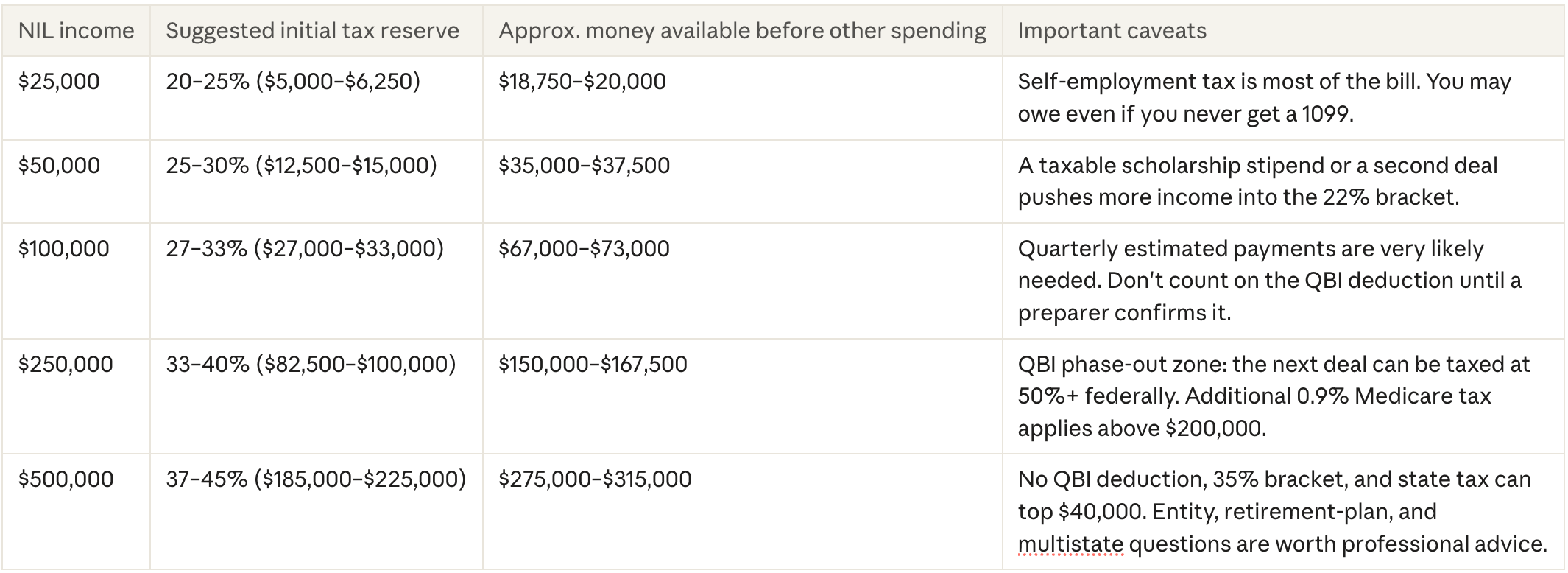
No QBI deduction, 35% bracket, and state tax can top $40,000. Entity, retirement-plan, and multistate questions are worth professional advice.
“Money available before other spending” is exactly that: before the car, before helping family, before investing. It’s the starting line for a spending plan, not the amount left after one.
If your facts differ from the assumptions — real deductible expenses, royalty income, withholding, other income, a different state — your number will move, sometimes a lot. That’s the point of the next sections.
Here’s a distinction that trips up almost every first-time NIL earner: owing tax and paying tax happen on different schedules.
You owe tax as you earn the income. The U.S. system is pay-as-you-go: the IRS says plainly that tax must be paid during the year, through withholding or estimated payments. Employees satisfy that automatically through their paychecks. If nobody withholds from your NIL income, the tool for paying as you go is the quarterly estimated tax payment, made with Form 1040-ES. Those payments cover self-employment tax as well as income tax.
Generally, you’re expected to make estimated payments if you expect to owe $1,000 or more when you file. For the 2026 tax year, the federal due dates are:
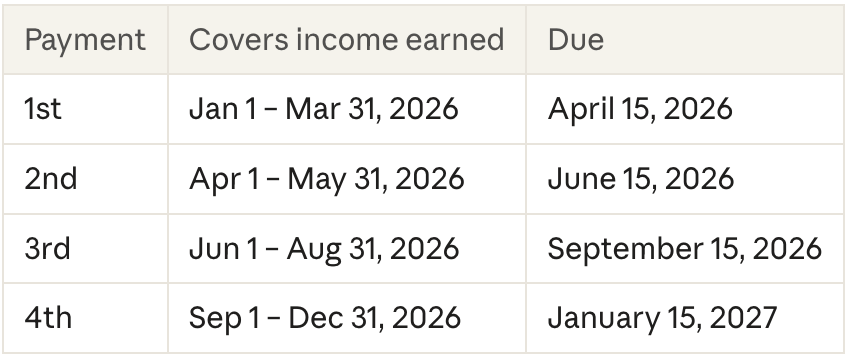
Notice the “quarters” aren’t equal. As of this writing, the next payment is the one due January 15, 2027. (According to the Form 1040-ES instructions, you can skip that fourth payment if you file your full 2026 return and pay the balance by February 1, 2027.)
Waiting until April creates two problems. The obvious one is a giant bill with the money already spent. The less obvious one is a penalty: if you don’t pay enough by each due date, the IRS can charge an underpayment penalty for each quarter you were short, even if you eventually pay everything with your return.
You generally avoid that penalty if what you paid during the year (estimates plus any withholding) covers the smaller of 90% of this year’s tax or 100% of last year’s tax — 110% of last year’s if last year’s adjusted gross income topped $150,000.
There’s also a quirk that matters for first-year NIL athletes. If you had zero tax liability for the prior full year and were a U.S. citizen or resident all year, you generally aren’t required to make estimated payments for the current year. A freshman whose 2025 tax was $0 may face no underpayment penalty on 2026 NIL income.
Read that carefully, though. It removes the penalty, not the tax. The full bill is still due in April. This exception is exactly how athletes end up with a five-figure balance and no money: nothing forced them to pay along the way.
Two practical notes. If your NIL income is lumpy — one big deal in August, nothing in spring — the annualized income method on Form 2210 can line up required payments with when you actually got paid. And states run their own estimated-tax systems. California, for example, front-loads its schedule, with no payment due in September and 70% of the year’s estimate due by June.
The simplest workable approach: every time NIL money arrives, move the reserve into a tax account, and at each due date, send the IRS (and your state) what’s accumulated.
Because NIL income is usually business income, you’re taxed on profit, not gross receipts. Legitimate business expenses reduce both income tax and self-employment tax, so a dollar of real deductions can save 25 to 40 cents or more.
The test is whether an expense is ordinary and necessary for your NIL business — common in that line of work and helpful for earning the income. Depending on the facts, that can include:
• Agent or marketing-agency commissions on NIL deals.
• Professional fees for a lawyer reviewing NIL contracts or a CPA preparing the business part of your return.
• Business travel, such as mileage or airfare to a paid appearance or shoot, with records showing the trip was for the deal.
• Content and marketing costs for the business: a photographer for sponsored content, editing software, a website, paid promotion.
• Equipment or supplies used to produce NIL content, allocated between business and personal use if you use them for both.
What doesn’t qualify is just as important. Being an NIL athlete doesn’t turn your life into a business expense. Your training, nutrition, and recovery primarily serve your sport, not your NIL business. Haircuts, everyday clothing, and sneakers you’d wear anyway are personal. The truck isn’t deductible because you sometimes drive to a signing. Money sent to family is a gift, not an expense. And if a brand pays you in gear or free services, that’s income at fair market value — not a write-off.
Two other items aren’t business expenses but do reduce income tax for many self-employed athletes: contributions to a self-employed retirement plan, such as a SEP-IRA or solo 401(k), and in some cases self-employed health insurance premiums. Both have eligibility rules worth checking with a professional.
The IRS’s NIL guidance is blunt about records: keep receipts, travel logs, and mileage logs. A deduction you can’t document is a deduction you may lose. The cleanest habit is a separate bank account and card used only for NIL business — your books essentially keep themselves.
Parents are often the de facto CFO of a young athlete’s NIL career. That can be a huge advantage, as long as everyone is clear about a few things.
Whose income is it? NIL income is generally the athlete’s income, reported on the athlete’s own return, because it’s earned from the athlete’s name, likeness, and services. Routing a payment through a parent’s bank account doesn’t make it the parent’s income. If the contract itself is unusual — a minor, a family-owned entity, a parent signing on the athlete’s behalf — that’s a question for a lawyer and a CPA together, not something to improvise.
Should parents control the tax account? There’s no single right answer, but a separate account that exists only for taxes is the important part. Some families keep it in the athlete’s name with a parent who has visibility. Others use a joint account. What matters is that the tax money never mixes with household money, and that the athlete understands what it’s for. A parent who quietly handles everything can accidentally raise an adult who doesn’t understand their own finances.
Watch the family-support trap. Helping family is one of the most meaningful things athletes do with NIL money. Just do it from after-tax dollars. Paying a parent’s mortgage out of money that was really the IRS’s creates two problems instead of one. And large transfers can have their own paperwork: for 2026 the annual gift-tax exclusion is $19,000 per recipient. Gifts above that generally require a gift tax return, even though actual gift tax is rare.
Dependency, royalties, and financial aid. If parents still claim the athlete as a dependent, coordinate the two returns. Royalty-type NIL income is unearned income, which in some situations can be taxed under the “kiddie tax” rules at the parents’ rate for full-time students under 24. And the IRS notes that NIL income must be included on the FAFSA and can affect financial aid, including Pell eligibility.
The most valuable thing a parent can do isn’t managing every dollar. It’s insisting, calmly and every single time, that the tax money moves first.
You are not the first, and this is fixable. The worst move is the most natural one: avoiding it until April. Tax problems grow with time; they almost never shrink. Here’s the sequence.
1. Figure out exactly how much you earned. Add up every NIL payment this year — collectives, brands, revenue share, appearances, and the fair market value of gear or services you received.
2. Gather contracts and payment records. Bank statements, payment-app history, contracts, any 1099s. The contract often tells you whether a payment was for services or a license.
3. Check whether anything was withheld. Don’t assume either way. If you got a W-2 from anyone, taxes may already have been taken out.
4. Talk to a tax professional now, not in April. Bring everything from steps 1 through 3. A good preparer can tell you what applies, what’s deductible, and what you can still do this year.
5. Estimate the liability. Use the ranges in this article as a first pass, then replace them with the professional’s number.
6. Stop treating new NIL payments as spending money. Every future payment funds the tax reserve first — including, for now, extra reserve to cover the shortfall.
7. Build the reserve going forward. Open a separate tax account and automate the transfer.
8. Decide on estimated payments. Making a payment by the next due date (January 15, 2027, for the current tax year) can cut down on penalties and shrinks the April bill.
One more thing worth knowing: if April comes and you can’t pay everything, file on time anyway. The penalty for not filing is generally far steeper than the penalty for not paying in full, and the IRS offers payment plans. An athlete who files, pays what they can, and sets up a plan is in a manageable situation. One who disappears is not.
Taxes feel like a math problem, but the expensive part is behavioral. A 19-year-old who sees $200,000 in an account will, quite reasonably, think of it as $200,000. The fix isn’t more willpower. It’s changing the order in which money moves.
The instinctive model looks like this:
Gross NIL income → spending
The model that keeps you out of trouble looks like this:
Gross NIL income → taxes → spending → savings and investments
Taxes come first not because they’re the most important thing in your life, but because they’re the only claim on the money that has a legal deadline. Once they’re set aside, everything left really is yours, and you can spend it without a nagging feeling that some of it isn’t.
Here’s the reserve framework to run on every payment.
1. Determine gross NIL income. What did you actually receive, including the value of non-cash compensation?
2. Determine whether taxes were withheld. Check the paperwork. A 1099 almost always means nothing was taken out; a W-2 usually means something was.
3. Estimate federal income tax. Consider your total taxable income for the year, deductions, and filing status — not just this one payment.
4. Estimate self-employment tax. Decide whether the payment was for services (usually yes) or a pure license (sometimes). If services, assume roughly 14% of net earnings.
5. Add state and local taxes. Based on where you live and where you did the work.
6. Add a margin of safety. A few percentage points covers deals you didn’t see coming and estimates that run low.
Then do the one thing that makes the framework real: move the reserve into a separate tax account the day the money arrives. Not at the end of the month. Not after you “figure out the exact number.” The same day.
In practice, most athletes do well with three accounts:
• NIL Income, where every payment lands;
• Tax Reserve, a high-yield savings account at a different bank from your everyday checking, which you never use for anything but taxes;
• Spending and Saving, which receives what’s left.
Say a $40,000 deal hits your NIL Income account and you’re a Texas athlete in the middle of the income range. Move about 28% — $11,200 — to Tax Reserve immediately. The $28,800 that remains is genuinely yours to budget, invest, or share. When each estimated-tax date comes around, pay from Tax Reserve. Any interest it earns along the way is a small bonus. If you over-saved, the surplus becomes savings after you file.
The separate account is doing psychological work, not just accounting work. Money you can’t see in your everyday balance is money you don’t mentally spend.
None of this is meant to make athletes afraid of their own money. NIL is a real opportunity, and athletes who earn it should enjoy it, share it, and build something with it.
The point is simply to know which part of the money is actually yours.
An NIL payment is income first and wealth second. It becomes wealth only after the government’s share is set aside. Athletes who internalize that early tend to keep what they earn. Athletes who learn it in April often spend the next year paying for a truck they already bought.
So the next time a big number lands in your account, let the first thought be a boring one:
“Before I spend this, I need to figure out what I owe Uncle Sam.”
Then move that money, and enjoy the rest.
This article is general education based on 2026 federal tax figures and illustrative state examples. It isn’t individualized tax, legal, or financial advice. Every athlete’s situation is different, and anyone with meaningful NIL income should work with a qualified professional.
Understanding your NIL tax obligations is an important first step, but tax planning is only one part of managing NIL income effectively. Decisions about saving, investing, budgeting, and preparing for life after college can have just as much impact on your long-term financial future. If you’re looking for personalized guidance, you can learn more about our financial planning services and comprehensive wealth management. The goal is to help you make the most of what you earn today while building a foundation for financial security long after your playing career ends.
Article written by Brady Lochte, founder of Axon Capital Management and a fee-only fiduciary financial advisor serving individuals and families across the Austin metro area. Brady is committed to providing clear, transparent financial guidance that helps people navigate retirement, investing, and long-term planning with confidence.
This article is general education based on 2026 federal tax figures and illustrative state examples. It isn’t individualized tax, legal, or financial advice. Every athlete’s situation is different, and anyone with meaningful NIL income should work with a qualified professional.
Please submit the form with any questions or comments and I'll be in touch shortly.
If you'd rather not wait, you can also book a time directly on my calendar using the link below:
Schedule a call
