

Say you've built up a healthy 401(k), some company stock, and an IRA or two left over from earlier jobs. Retirement is close enough to plan for in earnest, or your finances have simply gotten complicated enough that you want a professional involved. You search for "financial advisor Georgetown TX" and start reading websites.
Within a few minutes you've run into a dozen labels: fiduciary, fee-only, fee-based, wealth manager, financial planner, investment advisor, broker. Some firms put "fiduciary" at the top of the homepage. Others never mention it. Nearly all of them say they put clients first.
What do these terms actually mean, and does it matter who you hire?
It matters, though not always in the way the marketing suggests. "Financial advisor" is a title, not a legal category. The person behind it might be an investment adviser representative who owes you a fiduciary duty, a broker-dealer representative working under Regulation Best Interest, an insurance agent licensed under state insurance law, or someone who holds more than one of those roles and moves between them depending on the account. Each role comes with a different legal standard, a different way of getting paid, and a different set of conflicts. The rest of this article explains those differences so you can ask sharper questions before you hand over your savings.
A fiduciary is someone legally required to act in another person's best interest. In the investment world, the clearest example is a registered investment adviser. Under the Investment Advisers Act of 1940, an investment adviser is a fiduciary to its clients, and in 2019 the SEC spelled out what that means in its interpreation of the adviser standard of conduct: a duty of care and a duty of loyalty that together require the adviser to serve the client's best interest throughout the relationship. (Regulators spell it "adviser"; most firms write "advisor." They mean the same thing.)
The duty of care is about the quality of the advice. The adviser has to understand your finances, goals, and tolerance for risk well enough to give advice that actually fits you, seek the best execution available when it chooses where your trades are placed, and keep monitoring when the relationship is ongoing. The duty of loyalty is about whose interests come first. An adviser can't put its own interests ahead of yours, and it has to either eliminate a conflict of interest or disclose it clearly enough that you can give informed consent. A vague sentence buried in a contract doesn't meet that bar.
Two features make this standard different in practice. First, it covers the entire advisory relationship, including advice about strategy, account type, and whether to roll over a 401(k), not just the moment a particular fund is recommended. Second, it can't be waived. You and your adviser can define the scope of the work (managing your IRA but not your spouse's 401(k), for example), but within that scope the duty stays in place.
The duty doesn't depend on which regulator a firm answers to. According to the SEC's Investor.gov, advisers managing less than $100 million are generally registered with their state securities regulator, which in Texas is the Texas State Securities Board, while larger firms generally register with the SEC. The individuals who give advice on behalf of either kind of firm are registered with the states as investment adviser representatives.
There is also a professional fiduciary standard that sits on top of the law. The CFP Board requires CFP® professionals to act as fiduciaries at all times when they provide financial advice to a client. That obligation comes from the certification rather than securities law, and it applies regardless of how the CFP® professional is registered or paid.
"Non-fiduciary" usually describes a professional whose obligations to you come from a legal standard other than an investment adviser's fiduciary duty. Most often that means a registered representative of a broker-dealer, or an insurance agent. The label says nothing about competence or integrity. Many brokers and insurance professionals are careful and well trained, and some investors are genuinely better served by a transactional relationship than by paying an ongoing advisory fee.
Broker-dealers are regulated by the SEC and FINRA. Since June 30, 2020, when a broker-dealer recommends a securities transaction or investment strategy to a retail customer, including a recommendation about what type of account to open or whether to roll over a retirement plan, it has to follow Regulation Best Interest. Reg BI requires the broker to act in your best interest at the time of the recommendation and not to put its own financial interest ahead of yours. The rule has four parts: disclosure of fees, conflicts, and the capacity the broker is acting in; a care obligation to have a reasonable basis for believing the recommendation is in your best interest; policies to identify and address conflicts, including eliminating sales contests and quotas tied to specific products over limited periods; and compliance procedures to enforce all of it.
Reg BI raised the bar well above the old suitability standard, and its conflict requirements can't be satisfied by disclosure alone. But it is not the fiduciary duty that applies to investment advisers, and the differences are practical ones. Reg BI attaches to each recommendation when it's made, while an adviser's duty runs through the whole relationship. A broker generally has no obligation to keep monitoring your account afterward unless it agrees to. And because Reg BI governs recommendations, a trade you initiate on your own isn't evaluated the same way. As Investor.gov puts it, brokers must act in your best interest when recommending, but the way they are paid creates conflicts you should ask about.
Titles add another wrinkle. Under Reg BI, a broker-dealer that isn't also registered as an investment adviser, or a representative who isn't also an investment adviser representative, is presumed to violate the rule if it uses "adviser" or "advisor" in its name or title. As a result, many people whose business card says "Financial Advisor" are dually registered: they act as a broker on some accounts and as a fiduciary adviser on others. That arrangement is common and legitimate, but you should know which role applies to each account and each recommendation.
Two other standards round out the picture. Insurance agents who sell fixed annuities or life insurance are licensed and regulated under Texas insurance law rather than Reg BI. And for retirement accounts, the Department of Labor has its own definition of fiduciary investment advice under ERISA. A 2024 rule that would have extended fiduciary status to more one-time recommendations, including many rollovers, was vacated in 2026, and the older 1975 test still applies. Whether a single rollover recommendation counts as fiduciary advice under ERISA therefore depends on the facts.
The table below compares the two most common relationships. It describes typical arrangements, not guarantees; any individual firm can differ, which is why the documents and questions in the last row matter.
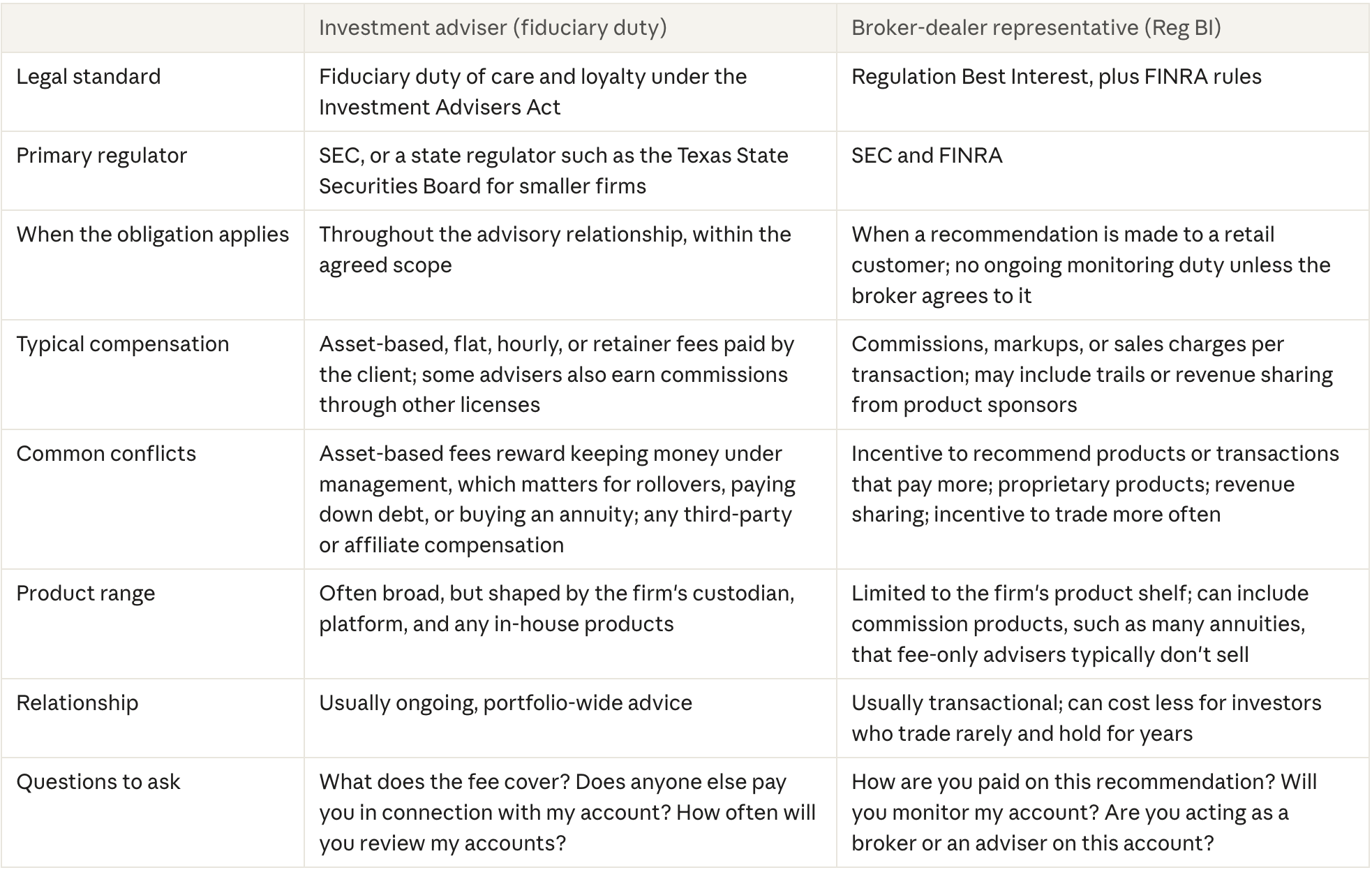
Dually registered professionals can fall in either column depending on the account, and insurance-only agents fall outside both. Sources: SEC adviser interpretation, Investor.gov on brokers and advisers.
No. "Fiduciary" describes a legal duty. "Fee-only" describes how someone gets paid. The two often travel together, but they answer different questions, and you need both answers.
Fiduciary ≠ fee-only. An investment adviser owes a fiduciary duty whether it charges a percentage of assets, a flat fee, or an hourly rate. Some fiduciary advisers also earn commissions: an adviser who is licensed to sell insurance, say, or a dually registered professional who manages one account for a fee and sells a commission product in another. They are still fiduciaries in their advisory role. They simply have an additional source of pay that brings its own conflicts, which should be disclosed.
Fee-only ≠ automatically fiduciary. Fee-only means the professional is paid only by clients, with no commissions or other sales-related compensation. The CFP Board, for example, lets a CFP® professional use the term only if neither the professional nor the firm receives sales-related compensation, and related parties don't receive it in connection with the client work. But fee-only is a description of compensation, not a registration or a license. Someone can charge a flat fee for budgeting or money coaching that never touches investment advice and isn't a registered adviser at all, so check registration separately. Fee-only also doesn't mean conflict-free. An adviser paid on assets under management earns more when more of your money stays in managed accounts, which is a real consideration when you're deciding whether to pay off a mortgage, fund a business, buy an annuity, or roll a 401(k) into an IRA.
Here is how the three common compensation models work in practice.
Fee-only. Every dollar comes directly from you: an asset-based fee (1% a year on a $500,000 portfolio is $5,000), a flat fee for a financial plan, an hourly rate, or an annual retainer. No commissions, trails, or revenue sharing.
Fee-based. This is industry shorthand, and an imprecise one. It usually means the professional charges fees and can also earn commissions. A typical example is an advisor who manages your IRA for an annual fee and also sells you a variable annuity or a life insurance policy on commission. The CFP Board prefers the term "fee and commission" and requires CFP® professionals who say "fee-based" to make clear they are not fee-only. Some firms also use "fee-based" to describe any advisory account with an asset-based fee, which is one more reason to ask exactly what it means.
Commission-based. The professional is paid through the products or transactions: a sales charge on a mutual fund, a commission on an annuity, a markup on a bond. You may not write a check, but the cost is real; it's built into the product or the trade. For an investor who buys a handful of funds and holds them for years, this can cost less than an ongoing asset-based fee, a point Investor.gov makes directly.
None of these models is virtuous on its own. What matters is whether the way your advisor is paid fits the work you want done, and whether you can account for every dollar of it.
These ten questions will tell you more than any website. Ask them in the first meeting, and ask for the important answers in writing.
The legal standard and the fee structure tell you how an advisor is obligated to behave. They don't tell you whether the advisor understands your situation. Georgetown households vary widely: Sun City is home to thousands of retirees, many younger families commute to Round Rock and north Austin, and the city has a growing base of small-business owners. The right advisor for one of those households can be a poor fit for another, so look for real experience with the problems you actually have.
Retirement income and Social Security. Building a portfolio and living off one are different jobs. Ask how an advisor decides which accounts to draw from first, how much to hold in cash or bonds for the next few years of spending, and when to claim Social Security. This matters for retired teachers in particular, since many Texas school districts don't participate in Social Security. The Social Security Fairness Act, signed in January 2025, ended the Windfall Elimination Provision and Government Pension Offset, which raised benefits for many people with pensions from work not covered by Social Security. If that describes you or your spouse, claiming decisions made under the old rules deserve a second look.
Tax-aware planning. Texas has no state income tax, so planning centers on federal brackets: Roth conversions in the years between retirement and required minimum distributions, harvesting losses, deciding which investments belong in taxable versus retirement accounts, and timing large capital gains. Property taxes are a permanent line in a Texas retirement budget, and a good plan treats them that way.
Equity compensation and concentrated stock. Many Georgetown residents work for technology and semiconductor employers across the Austin metro. RSUs, incentive and non-qualified stock options, and ESPP shares are each taxed differently, and a large position in your employer's stock ties your paycheck and your portfolio to the same company. Ask a prospective advisor how they would handle a large RSU vest, an ISO exercise that could trigger the alternative minimum tax, or a plan to reduce a concentrated position over several tax years.
Business-owner planning. Owners need help with retirement plan design (solo 401(k), SEP IRA, or something larger), owner compensation decisions made with their CPA, and planning for an eventual sale or succession.
Coordination with your other professionals. Your investment plan, tax return, and estate documents should agree with one another. Texas is a community property state, which affects how assets are titled and passed on. Ask whether the advisor works directly with your CPA and estate attorney or leaves that coordination to you.
Finally, don't let geography make the decision for you. A financial advisor in Georgetown has real advantages, including a face-to-face meeting before a big decision. But much of financial planning now happens by video and shared documents, and a qualified advisor elsewhere in Central Texas may serve you just as well. Choose on legal standard, compensation, expertise, and fit first. If you consider a firm based outside Texas, confirm that it is registered or has notice-filed to work with Texas clients.
Axon Capital Management is an independent, fee-only investment adviser based in Georgetown and registered with the Texas State Securities Board. We work with individuals and families in Georgetown, the greater Austin area, and throughout Texas. As an investment adviser, we owe our clients a fiduciary duty, and as a fee-only firm we are paid only by our clients: no commissions, and no proprietary products.
Clients work with us in one of two ways. Ongoing clients pay an asset-based fee that covers investment management and continuing financial planning: diversified, tax-aware portfolios, regular rebalancing, and ongoing work on retirement planning, tax planning, and equity compensation. Others hire us for a one-time, flat-fee financial plan that they implement on their own. Both fee schedules are published on our pricing page, and our Form ADV is available on the SEC's Investment Adviser Public Disclosure site.
Much of our work involves the situations described above: professionals with RSUs, stock options, or a concentrated position; pre-retirees planning the shift from a paycheck to portfolio withdrawals; and households that want investments, taxes, and retirement decisions handled as one plan, alongside their CPA and attorney. Being fee-only doesn't remove every conflict. An asset-based fee is a conflict of its own, and we disclose it. What it does is keep product sales out of the conversation. You can learn more about our firm or schedule a consultation.
Whether someone calls themselves a financial advisor tells you very little. The title starts the conversation; it doesn't finish it. The question worth answering before you hire anyone is this:
What legal standard applies to the relationship, how is the advisor compensated, what conflicts exist, and what exactly are you paying them to do?
For many Georgetown investors, especially those who want ongoing, coordinated advice, a fee-only fiduciary adviser will be the right answer. For others, a broker or a dually registered professional will be a perfectly good fit. Either way, get the answers in writing, read the Form ADV or Form CRS, and verify registration on Investor.gov before you move your investments or sign an advisory agreement.
Article written by Brady Lochte, founder of Axon Capital Management and a fee-only fiduciary financial advisor serving individuals and families across the Austin metro area. Brady is committed to providing clear, transparent financial guidance that helps people navigate retirement, investing, and long-term planning with confidence.
This article is for educational purposes only and is not individualized investment, tax, or legal advice. Axon Capital Management is an investment adviser registered with the Texas State Securities Board. Registration does not imply a certain level of skill or training.
Please submit the form with any questions or comments and I'll be in touch shortly.
If you'd rather not wait, you can also book a time directly on my calendar using the link below:
Schedule a call
